

Essential Instrumentation and Control Systems Used in UK LNG and Natural Gas Processing Facilities

Essential Instrumentation and Control Systems Used in UK LNG and Natural Gas Processing Facilities
Where to Start With LNG Instrumentation in the UK?

LNG is natural gas cooled to roughly −162 °C so it can be shipped and stored as a liquid. At that temperature, a poorly chosen transmitter, a drifting flow meter or an untested gas detector costs far more than the instrument itself. The instruments are only half the story. The control and safety systems that act on their signals decide whether a small deviation stays small. The UK picture differs from the US one. The UK is an importing market. Its three large terminals, Isle of Grain, South Hook and Dragon, receive cargoes, store the LNG and regasify it into the National Transmission System. Alongside them sit gas terminals and processing sites that handle North Sea gas, and smaller LNG storage sites regulated under the same major-hazard rules. Instrument choice here is shaped by COMAH, DSEAR, UK conformity marking and the commercial rules that govern cargo and gas measurement.

What does LNG and natural gas processing instrumentation cover?

It is everything that measures, detects and protects across the facility: transmitters, flow meters, level gauges, temperature sensors, gas and flame detectors, vibration monitors and the calibration equipment that keeps them honest. At an import terminal, that means ship-to-shore transfer, cryogenic pipework, storage tanks, boil-off gas (BOG) handling, vaporisers and send-out to the grid. At a natural gas processing site or gas terminal, it covers inlet separation, compression, dehydration, gas conditioning and export metering. The measured variables are the same on both: pressure, temperature, flow, level, gas safety and machine health. What differs is temperature, accuracy requirements and how severe the consequences of failure are.

How an LNG instrumentation system fits together?

Think of it as a chain. A field device measures something, such as the pressure in a vaporiser outlet line. A transmitter converts that into a signal, usually 4-20 mA with HART on top. The signal goes to the control system for LNG process control, and to the safety system if a shutdown is needed. Diagnostic and trend data can then pass to asset management or historian software. A weak link anywhere, whether a wrongly ranged transmitter or a detector that was never tested, undermines everything after it.

The control systems behind the instruments

Four layers of control and safety work together on a UK LNG or gas processing site. They are usually kept separate on purpose.

Basic process control (DCS or PLC)

This layer runs the plant day to day. It holds pressures, temperatures, levels and flows at their setpoints using transmitter signals. Control valves and positioners act on those signals, so accurate field instruments directly affect control quality.

Safety instrumented systems (ESD / SIS)

When the process leaves safe limits, this layer takes the plant to a safe state. IEC 61511 is the widely used design basis, which is why SIL-rated instruments appear in specifications. Typical LNG functions include high-high tank level protection and shutdown on high pressure.

Fire and gas systems (F&G)

Gas and flame detectors feed a dedicated logic solver that raises alarms and triggers actions such as isolation or shutdown. Detector placement and voting logic shape how well the system performs. Routine testing matters as much as the hardware itself.

Machinery protection

Vibration, axial position and speed monitoring on compressors, pumps and turbines is normally a standalone system. That keeps it working if the main control system has a problem. Our Bently Nevada vibration monitoring buyer's guide explains how this layer is built.

The four technology groups

1. Process and custody measurement

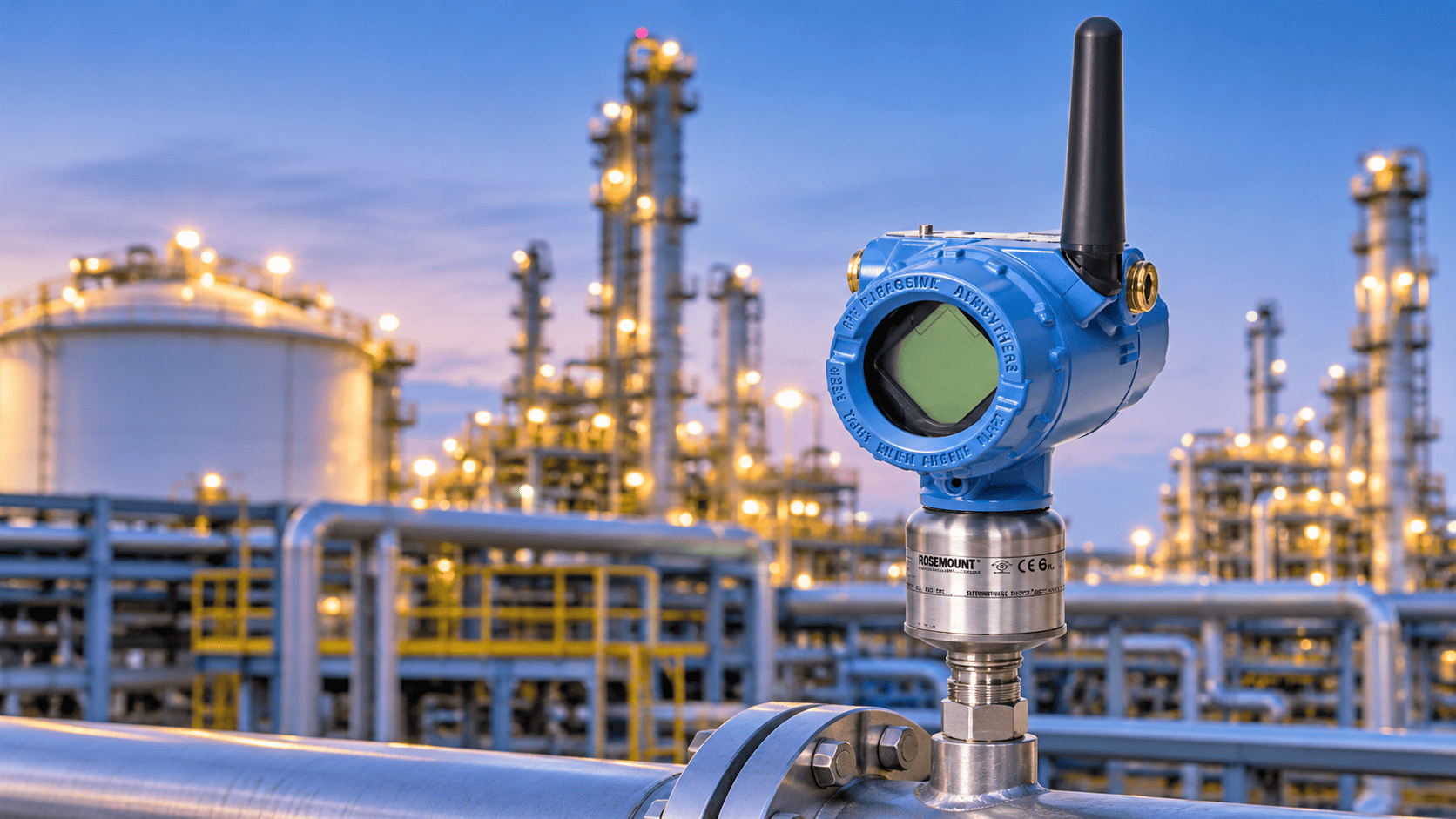
Pressure, temperature, flow and level instruments feed the control system and, in many cases, the commercial accounts. Smart pressure transmitters from the Rosemount range are the workhorse of most sites.

2. Safety and detection

Combustible gas detectors, flame detectors and optical gas imaging protect people and plant. Our Net Safety Monitoring range covers continuous area protection.

3. Machinery protection

Boil-off gas compressors, cryogenic pumps, gas turbines and large process compressors need continuous vibration and position monitoring. Bently Nevada is the name most operators know for this job.
4. Calibration and final control Pressure and process calibrators keep measurements accurate, and control valves and positioners act on them. Our Druck Fisher control valves close the loop.

Why cryogenic service changes the specification?

Standard process instruments are not automatically suitable for LNG. Before ordering, check the datasheet for these points:
  • Temperature rating: confirm the instrument and its materials are rated for the actual minimum process temperature, not just ambient.
  • Materials: wetted parts and seals must stay stable at cryogenic temperatures.
  • Extended mounting:some cryogenic transmitters sit away from the cold line to keep electronics in range, which affects installation and impulse-line design.
  • Tank level and density: large storage tanks commonly combine level gauging with temperature profiling, because layers of different density can form in stored LNG and lead to a sudden mixing event known as rollover.

Gas flow measurement: where accuracy turns into money

Gas flow measurement is where accuracy has the most direct financial value. It drives billing, allocation and sometimes emissions reporting. The usual technologies are:
  • Ultrasonic meters are popular on larger gas lines because they cause very little pressure drop. Panametricsis a well-known name here.
  • Coriolis metersmeasure mass flow and density directly, which suits liquids and accurate transfer points.
  • Differential pressure (orifice) systems remain common and are built around ISO 5167. They rely on accurate DP transmitters, so a good Rosemount pressure transmitter selection matters.
Flow is only part of the picture. Energy-based gas trading also depends on gas composition and calorific value, and LNG cargo transfers follow industry practice such as the GIIGNLcustody transfer guidance and the terms of the sale contract. Upstream, the North Sea Transition Authority sets expectations for fiscal oil and gas measurement on the UK Continental Shelf. That regime covers upstream production, so for a downstream terminal, check which rules your contracts and operating licence actually apply.

How the technologies work together?

Start with process measurement. Pressure transmitters sit on vessels, vaporiser lines and send-out headers, and HART diagnostics can flag problems such as a blocked impulse line without a technician climbing the structure. Then comes the safety layer. Teledyne FLIR optical gas imaging cameras complement fixed detection by letting inspectors see leaks that would otherwise be invisible. Rotating equipment gets its own protection. Compressor and turbine packages commonly specify machinery protection to API Standard 670, which covers vibration, axial position, speed and temperature monitoring. Rack-based monitors such as the Bently Nevada 3500 are widely used for that job, and our 3500 Series selection guide explains how the modules fit together. Finally, there is the part that gets forgotten. Calibrators from Flukelet you verify instruments in the field and keep records an auditor will accept. Our calibration and service tipsshow how to keep that routine manageable.

Technology comparison

Technology Measures Best for
Smart pressure transmitter Gauge, absolute or differential pressure Vessels, vaporisers, send-out lines, DP flow
Temperature sensor (RTD / thermocouple) Process and equipment temperature Cryogenic lines, tanks, heaters, bearings
Coriolis flow meter Mass flow and density Liquid transfer and accurate allocation points
Ultrasonic flow meter Volumetric flow Larger gas lines, low pressure drop
Radar level gauge Level Storage tanks, vessels, knock-out drums
Fixed gas detector Combustible and toxic gas Continuous area protection
Flame detector (UV/IR) Flame presence Compressor areas, loading and process units
Optical gas imaging camera Visualises gas leaks Leak inspection and emissions surveys
Proximity probe system Shaft vibration and position Critical compressors, turbines and large pumps
Process calibrator Pressure, mA, voltage, temperature Field calibration and documented checks

Choosing between similar instruments

Coriolis or ultrasonic? Coriolis gives direct mass flow and density and is hard to beat for liquid accuracy. Ultrasonic suits larger gas lines where pressure drop must stay low. Choose by fluid, line size and the accuracy your contract needs. Rosemount 2051 or 2088? Both are pressure transmitters, but they differ in measurement types and configuration options. Check the full model code against your range and process connections before ordering. Our 2051 vs 2088 guide explains the difference. Point or open-path gas detection? Point detectors measure gas at one location and are simple and widely used. Open-path detectors cover a line across the site and suit open areas such as tank farms and jetties. Many sites use both. Full rack or simple transmitter for machinery? Critical machines need a full protection system. For simpler loops, a Bently Nevada 990 vibration transmitter gives a 4-20 mA signal to your PLC. See our vibration monitoring buyer’s guide for more.

UK regulations and certification: what to check

Instruments are only useful if you can show they are fit for where they are installed. LNG terminals fall under the Control of Major Accident Hazards Regulations (COMAH). HSE explains its role as lead agency for LNG safety, working with the Environment Agency in England and Wales. Instrumentation for gas detection, shutdown and overpressure protection forms part of the evidence that a major-hazard site relies on, so changes are not purely a maintenance decision. For hazardous areas, employers must classify areas where explosive atmospheres may form into zones under the Dangerous Substances and Explosive Atmospheres Regulations 2002 (DSEAR). HSE’s technical guidance on hazardous area classification notes that BS EN 60079-10-1 is the most commonly used UK standard for working out the extent and classification of an area. Onshore LNG installation design commonly references BS EN 1473.
Topic What to check Why it matters
Area classification Zone, gas group and temperature class for the location The instrument’s certificate must match the zone it goes into.
Product marking UKCA / UKEX or CE marking, as applicable to your equipment Equipment for explosive atmospheres must carry the right conformity marking.
Imported equipment US datasheets showing only Class / Division, UL, FM or CSA These are not the same as UK or EU certification.
Units and ranges bar, °C and m³ against psi, °F and scf A wrongly read range can mean a wrongly set alarm.
Cryogenic suitability Minimum service temperature on the datasheet Ambient ratings do not guarantee cold-service performance.
Documentation Declaration of conformity and certificates Your compliance team and auditors will ask for them.
Equipment for explosive atmospheres supplied into Great Britain falls under the 2016 regulations, and there is official GOV.UK guidance on how they apply. Northern Ireland follows its own arrangements, so check which applies to your site. If you are buying US-specified equipment and are unsure what the UK paperwork should look like, send us the datasheet and we will help you check it.

Did you know?

  • HART lets you read instrument diagnostics over the same wiring that carries the 4-20 mA signal.
  • Coriolis meters measure mass flow directly, so they do not need pressure and temperature compensation to find mass.
  • Feeding vibration data into asset management software is where much of the return comes from. Our post on the ROI of integrating Bently Nevada with IoT explains why.
  • A well-chosen, correctly installed and regularly calibrated transmitter usually beats an advanced system fed with bad data.

Which instruments for which UK application?

LNG import and regasification terminal

Cryogenic temperature and level measurement, pressure transmitters on vaporiser and send-out lines, accurate flow measurement, extensive gas and flame detection, and machinery protection on BOG compressors and pumps.

Natural gas processing site or gas terminal

Inlet and export flow measurement, pressure and temperature, gas detection, and machinery monitoring on compression. For wet or outdoor locations, the Velomitor XA velocity sensor is a common choice.

Small-scale LNG and peak-shaving storage

Pressure and level instrumentation, gas detection and a documented calibration programme suited to COMAH expectations.

Large LNG and gas projects

Machinery protection on large compressors and turbines, accurate flow measurement and extensive safety systems. For a sense of scale, see our write-up of the Pluto Train 2 LNG project.

Ageing and late-life assets

Direct replacements for obsolete transmitters, spares for critical protection and calibration equipment so you can keep proving older instruments still perform. See our wider oil and gas instrumentation guide for UK buyers.

Five steps to choose your LNG instrumentation

  1. Define the duty. Fluid, pressure, minimum and maximum temperature, and what happens if the instrument fails.
  2. Confirm the area classification. UK zone, gas group and temperature class, and the certification that applies at your site.
  3. Match the output and communication to your control and safety systems. 4-20 mA, HART, WirelessHART or a fieldbus.
  4. Check range, materials and units. Confirm the full model code, not only the base part number, and make sure the cryogenic rating is stated.
  5. Plan spares and calibration. Keep critical spares and a way to verify replacements. Our article on reducing downtime with predictive asset protection shows what that can save.

Buying LNG instrumentation in the UK

Qinstrument is based in Dublin, Ireland, and supplies instrumentation from brands including Bently Nevada, Rosemount, Druck, Fluke, Net Safety, Teledyne FLIR and Panametrics to customers across the UK and EU. You can read more about us if you would like to know who you are dealing with. Whether your site is in England, Scotland, Wales or Northern Ireland, send us your part numbers or datasheets and we will confirm availability and quote. Shipments into Great Britain and Northern Ireland can involve customs paperwork, VAT and duties. We offer delivery with duties and taxes included, so there are no extra charges on delivery. Please confirm the terms on your quote. For equipment going into hazardous or cryogenic areas, check the datasheet and your site’s compliance requirements, including any markings needed in your region, before you order.

Need a quote on LNG instrumentation in the UK?

Send us the part numbers, datasheet or a description of your application and we will confirm and quote. We deliver across the UK and EU with duties and taxes included.