

- Test and Measurement Instruments at Unbeatable Prices!
- Worldwide Shipping Available
Essential Instrumentation and Control Systems Used in UK LNG and Natural Gas Processing Facilities
Where to Start With LNG Instrumentation in the UK?
What does LNG and natural gas processing instrumentation cover?
How an LNG instrumentation system fits together?
The control systems behind the instruments
Basic process control (DCS or PLC)
This layer runs the plant day to day. It holds pressures, temperatures, levels and flows at their setpoints using transmitter signals. Control valves and positioners act on those signals, so accurate field instruments directly affect control quality.
Safety instrumented systems (ESD / SIS)
When the process leaves safe limits, this layer takes the plant to a safe state. IEC 61511 is the widely used design basis, which is why SIL-rated instruments appear in specifications. Typical LNG functions include high-high tank level protection and shutdown on high pressure.
Fire and gas systems (F&G)
Gas and flame detectors feed a dedicated logic solver that raises alarms and triggers actions such as isolation or shutdown. Detector placement and voting logic shape how well the system performs. Routine testing matters as much as the hardware itself.
Machinery protection
Vibration, axial position and speed monitoring on compressors, pumps and turbines is normally a standalone system. That keeps it working if the main control system has a problem. Our Bently Nevada vibration monitoring buyer's guide explains how this layer is built.
The four technology groups
1. Process and custody measurement
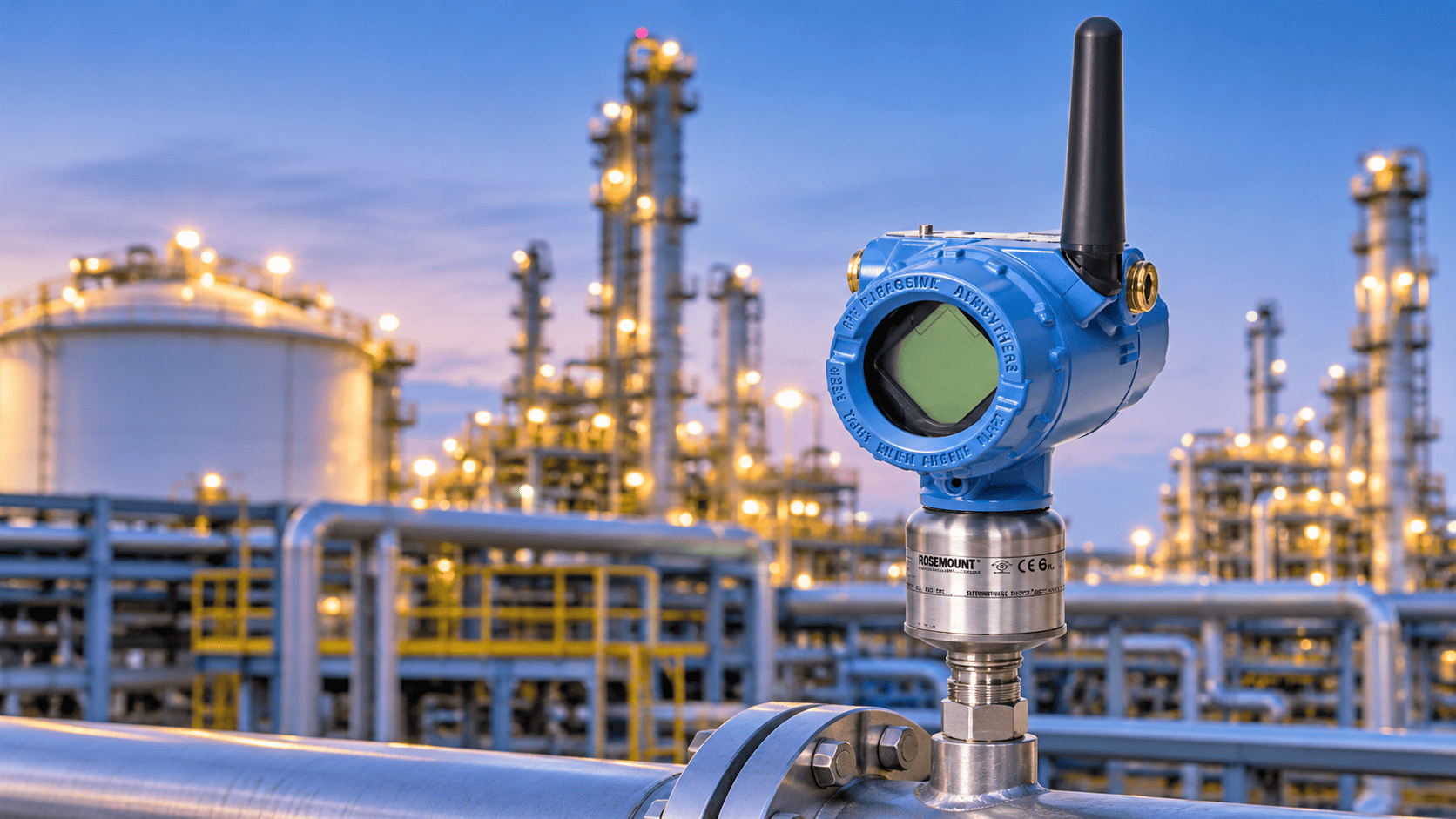
Pressure, temperature, flow and level instruments feed the control system and, in many cases, the commercial accounts. Smart pressure transmitters from the Rosemount range are the workhorse of most sites.2. Safety and detection
Combustible gas detectors, flame detectors and optical gas imaging protect people and plant. Our Net Safety Monitoring range covers continuous area protection.3. Machinery protection
Boil-off gas compressors, cryogenic pumps, gas turbines and large process compressors need continuous vibration and position monitoring. Bently Nevada is the name most operators know for this job.Why cryogenic service changes the specification?
- Temperature rating: confirm the instrument and its materials are rated for the actual minimum process temperature, not just ambient.
- Materials: wetted parts and seals must stay stable at cryogenic temperatures.
- Extended mounting:some cryogenic transmitters sit away from the cold line to keep electronics in range, which affects installation and impulse-line design.
- Tank level and density: large storage tanks commonly combine level gauging with temperature profiling, because layers of different density can form in stored LNG and lead to a sudden mixing event known as rollover.
Gas flow measurement: where accuracy turns into money
- Ultrasonic meters are popular on larger gas lines because they cause very little pressure drop. Panametricsis a well-known name here.
- Coriolis metersmeasure mass flow and density directly, which suits liquids and accurate transfer points.
- Differential pressure (orifice) systems remain common and are built around ISO 5167. They rely on accurate DP transmitters, so a good Rosemount pressure transmitter selection matters.
How the technologies work together?
Technology comparison
| Technology | Measures | Best for |
|---|---|---|
| Smart pressure transmitter | Gauge, absolute or differential pressure | Vessels, vaporisers, send-out lines, DP flow |
| Temperature sensor (RTD / thermocouple) | Process and equipment temperature | Cryogenic lines, tanks, heaters, bearings |
| Coriolis flow meter | Mass flow and density | Liquid transfer and accurate allocation points |
| Ultrasonic flow meter | Volumetric flow | Larger gas lines, low pressure drop |
| Radar level gauge | Level | Storage tanks, vessels, knock-out drums |
| Fixed gas detector | Combustible and toxic gas | Continuous area protection |
| Flame detector (UV/IR) | Flame presence | Compressor areas, loading and process units |
| Optical gas imaging camera | Visualises gas leaks | Leak inspection and emissions surveys |
| Proximity probe system | Shaft vibration and position | Critical compressors, turbines and large pumps |
| Process calibrator | Pressure, mA, voltage, temperature | Field calibration and documented checks |
Choosing between similar instruments
UK regulations and certification: what to check
| Topic | What to check | Why it matters |
|---|---|---|
| Area classification | Zone, gas group and temperature class for the location | The instrument’s certificate must match the zone it goes into. |
| Product marking | UKCA / UKEX or CE marking, as applicable to your equipment | Equipment for explosive atmospheres must carry the right conformity marking. |
| Imported equipment | US datasheets showing only Class / Division, UL, FM or CSA | These are not the same as UK or EU certification. |
| Units and ranges | bar, °C and m³ against psi, °F and scf | A wrongly read range can mean a wrongly set alarm. |
| Cryogenic suitability | Minimum service temperature on the datasheet | Ambient ratings do not guarantee cold-service performance. |
| Documentation | Declaration of conformity and certificates | Your compliance team and auditors will ask for them. |
Did you know?
- HART lets you read instrument diagnostics over the same wiring that carries the 4-20 mA signal.
- Coriolis meters measure mass flow directly, so they do not need pressure and temperature compensation to find mass.
- Feeding vibration data into asset management software is where much of the return comes from. Our post on the ROI of integrating Bently Nevada with IoT explains why.
- A well-chosen, correctly installed and regularly calibrated transmitter usually beats an advanced system fed with bad data.
Which instruments for which UK application?
LNG import and regasification terminal
Cryogenic temperature and level measurement, pressure transmitters on vaporiser and send-out lines, accurate flow measurement, extensive gas and flame detection, and machinery protection on BOG compressors and pumps.Natural gas processing site or gas terminal
Inlet and export flow measurement, pressure and temperature, gas detection, and machinery monitoring on compression. For wet or outdoor locations, the Velomitor XA velocity sensor is a common choice.Small-scale LNG and peak-shaving storage
Pressure and level instrumentation, gas detection and a documented calibration programme suited to COMAH expectations.Large LNG and gas projects
Machinery protection on large compressors and turbines, accurate flow measurement and extensive safety systems. For a sense of scale, see our write-up of the Pluto Train 2 LNG project.Ageing and late-life assets
Direct replacements for obsolete transmitters, spares for critical protection and calibration equipment so you can keep proving older instruments still perform. See our wider oil and gas instrumentation guide for UK buyers.Five steps to choose your LNG instrumentation
- Define the duty. Fluid, pressure, minimum and maximum temperature, and what happens if the instrument fails.
- Confirm the area classification. UK zone, gas group and temperature class, and the certification that applies at your site.
- Match the output and communication to your control and safety systems. 4-20 mA, HART, WirelessHART or a fieldbus.
- Check range, materials and units. Confirm the full model code, not only the base part number, and make sure the cryogenic rating is stated.
- Plan spares and calibration. Keep critical spares and a way to verify replacements. Our article on reducing downtime with predictive asset protection shows what that can save.
Buying LNG instrumentation in the UK
Need a quote on LNG instrumentation in the UK?
Posts Widget